.jpg)

Americans’ Perceptions of AAPIs Revealed in New Report

As the nation kicks off AAPI Heritage Month, we're unveiling the findings of The Asian American Foundation’s sixth annual Social Tracking of Asian Americans in the U.S. (STAATUS) Index.
Perceptions about the AAPI community have long shaped how we are treated in daily life and influence our safety, opportunity, and sense of place in the United States. That’s why since 2020, the STAATUS Index has set out to examine Americans’ perceptions of AAPI communities and is now widely used by policymakers, advocates, and journalists as a benchmark for our community’s progress.
This year’s survey, conducted by NORC at the University of Chicago, goes deeper than ever to examine the disconnect between how AAPIs experience life and how the rest of the country perceives us. Thanks to new questions developed with input from leading scholars, TAAF’s data and research team has eye-opening insights on how U.S. adults feel about everything from the growing cultural influence of AAPIs to what it means to be “truly American.”
Here are some key takeaways from the 2026 STAATUS Index:
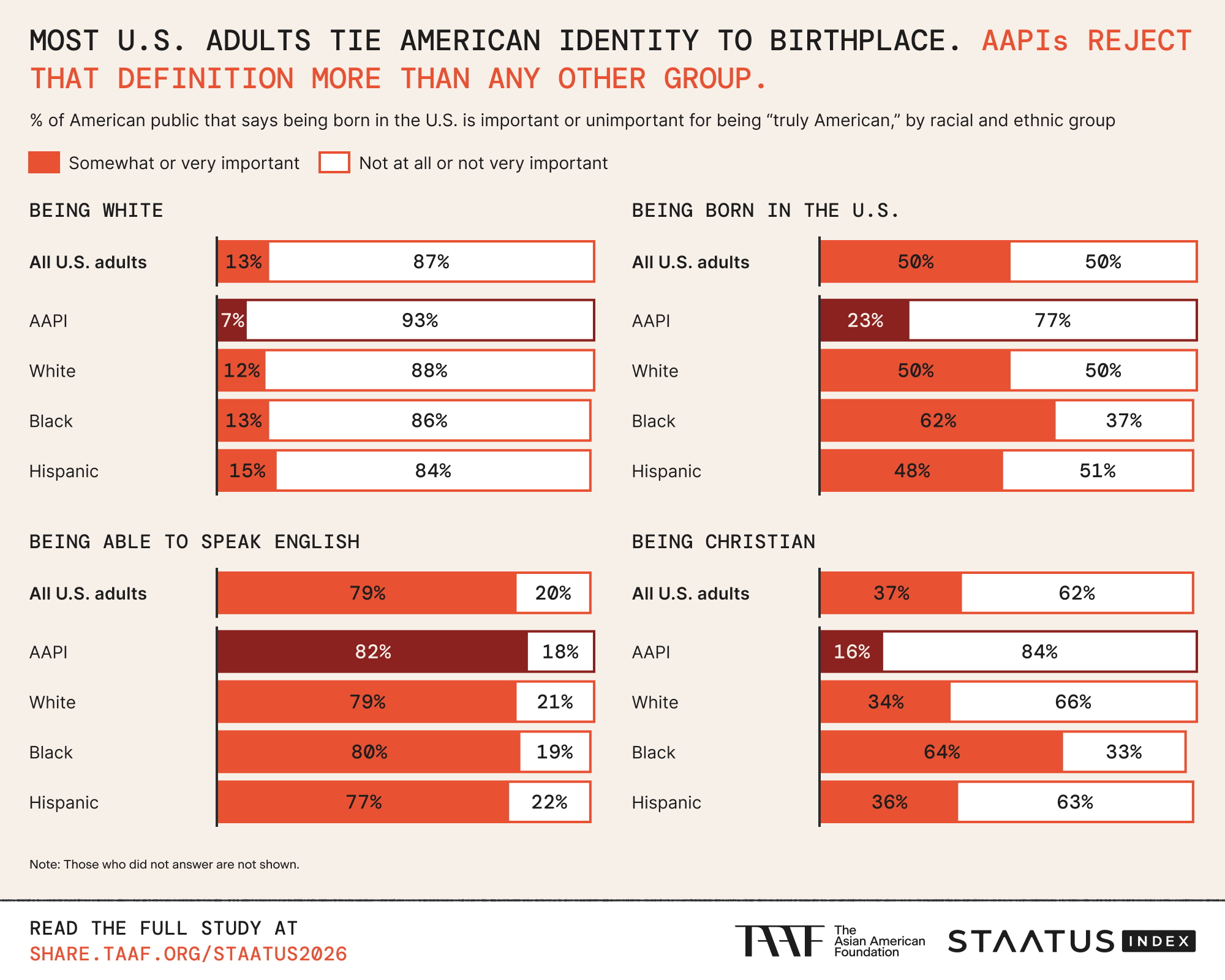
1. The public is split over who counts as “truly American” ahead of America’s 250th anniversary.
As the United States prepares to celebrate 250 years of independence, the 2026 STAATUS Index finds a country divided over a fundamental question: who gets to be “truly American.” Half of U.S. adults say being born in the United States is important to being “truly American,” yet 77% of AAPIs say it is not—more than any other racial or ethnic group. AAPIs are also among the most likely to reject definitions of American identity tied to being white or Christian, pointing to a broader and more inclusive understanding of belonging.
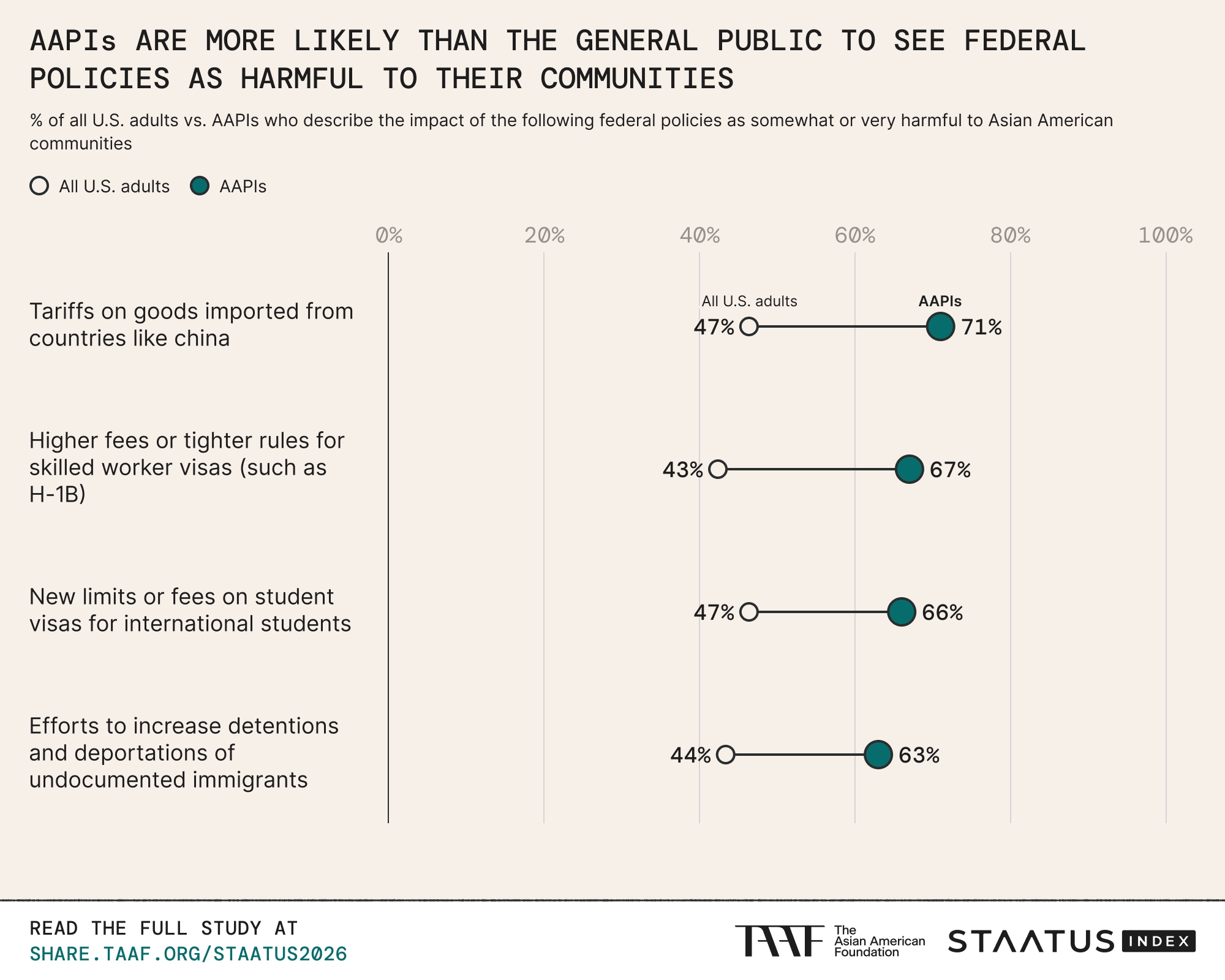
2. AAPIs are more likely than the general public to say recent federal policy changes have hurt Asian American communities.
From immigration enforcement to tariffs, federal policy has always shaped the lives of AAPI communities, but this year’s data reveals a significant disconnect. While less than half of all U.S. adults see recent federal actions as harmful to Asian Americans, a majority of AAPIs say otherwise.
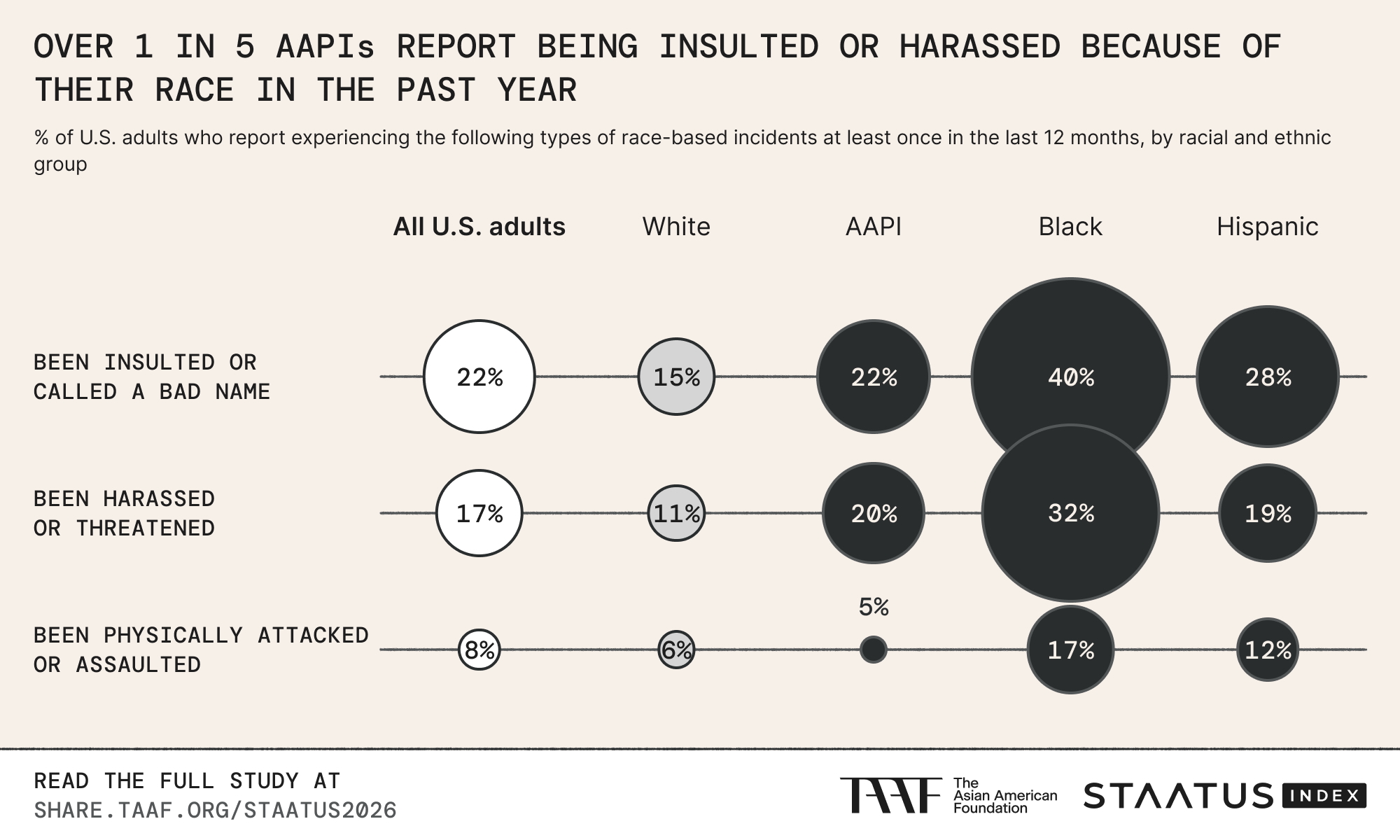
3. Worry is more top of mind for AAPIs than for other groups, as safety challenges remain.
Years after the pandemic-era surge in anti-Asian violence, the 2026 STAATUS Index shows safety concerns are still present realities, with 1 in 5 AAPI adults reporting being harassed, threatened, or insulted because of their race/ethnicity in the last 12 months.
When asked how they feel about life right now, Americans most often say hopeful (48%), including white (50%), Black (53%), and Hispanic Americans (44%). AAPIs are the only racial or ethnic group where worry (44%) outranks hope (40%).
4. Few U.S. adults believe AAPI communities have a great deal of influence on U.S. culture – but perceptions may be shifting.
Just 7% of U.S. adults believe AAPI communities have “a great deal” of influence on U.S. culture. Gen Zers (18-24) are somewhat more likely than older Americans (50+) to share that view, though differences are modest (11% vs. 4%). But perceptions may be shifting, with nearly 1 in 3 (32%) Americans perceiving AAPIs as having gained influence in the last five years.
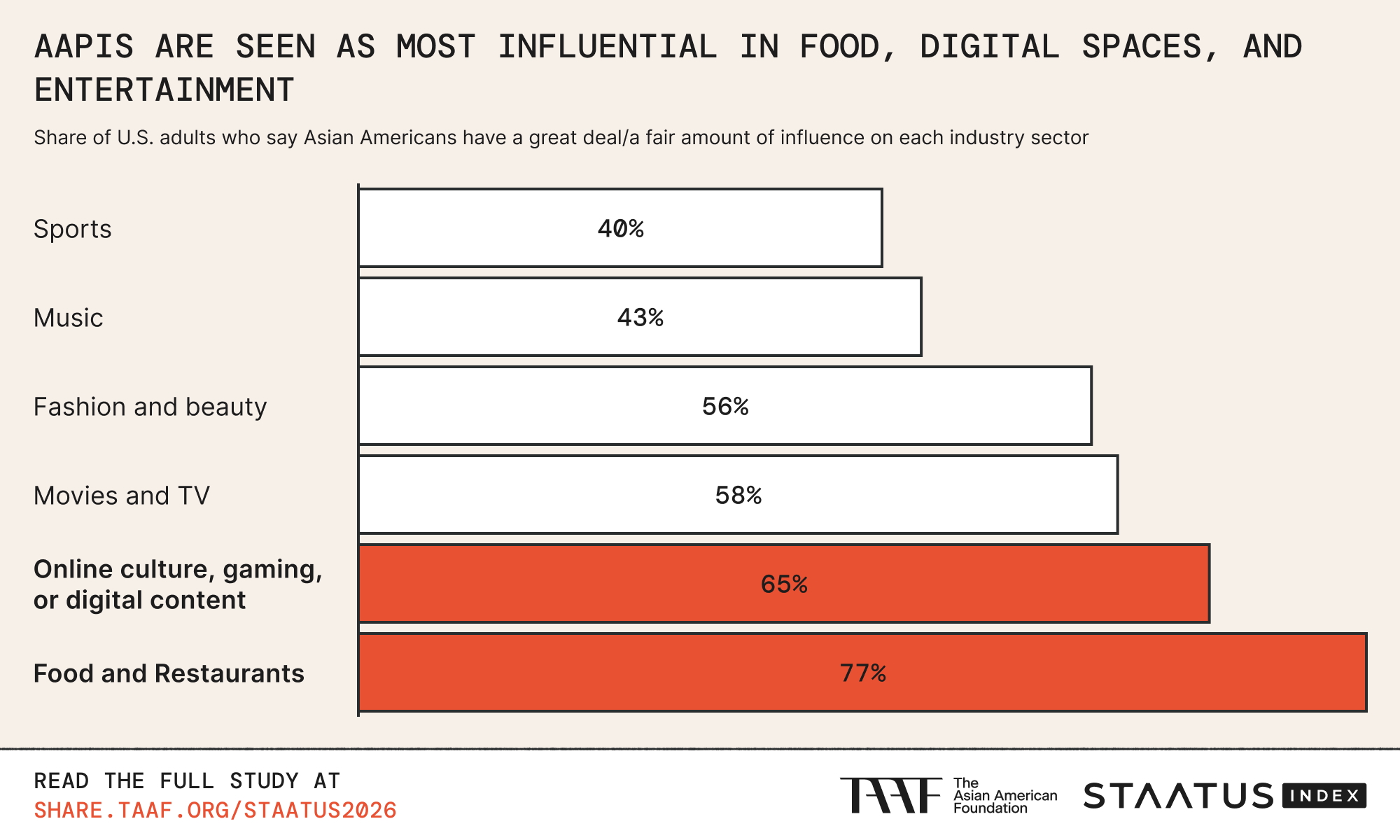
U.S. adults perceive AAPIs as having the most influence on the food and restaurant industry (77%), the online/gaming/digital content industry (65%), and the movies/TV industry (58%).
5. The American public wants to know more about AAPIs.
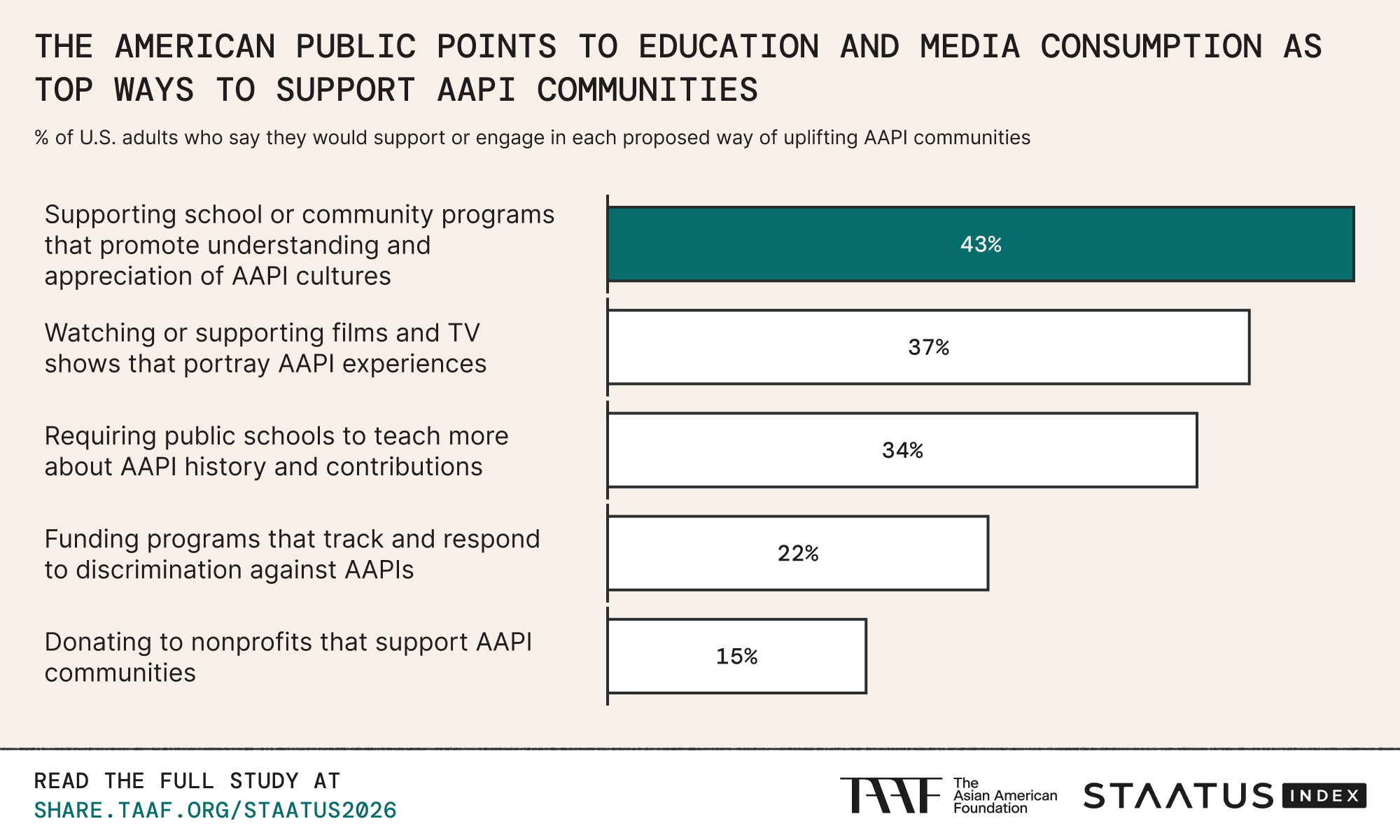
Over a quarter of the American public reports having none of seven common types of relationship (e.g. friends, family members, coworkers) with an Asian American and 53% cannot name a significant event or policy in Asian American U.S. history. Still, there are signs of openness to connections with Asian Americans, including strong support for education, engagement and AAPI-owned businesses.
These are just a few of the findings from the 2026 STAATUS Index, and we’re excited for you to explore the data. Read our full report now at share.taaf.org/STAATUS2026.
If you’re a journalist interested in covering the findings, please reach us at press@taaf.org.