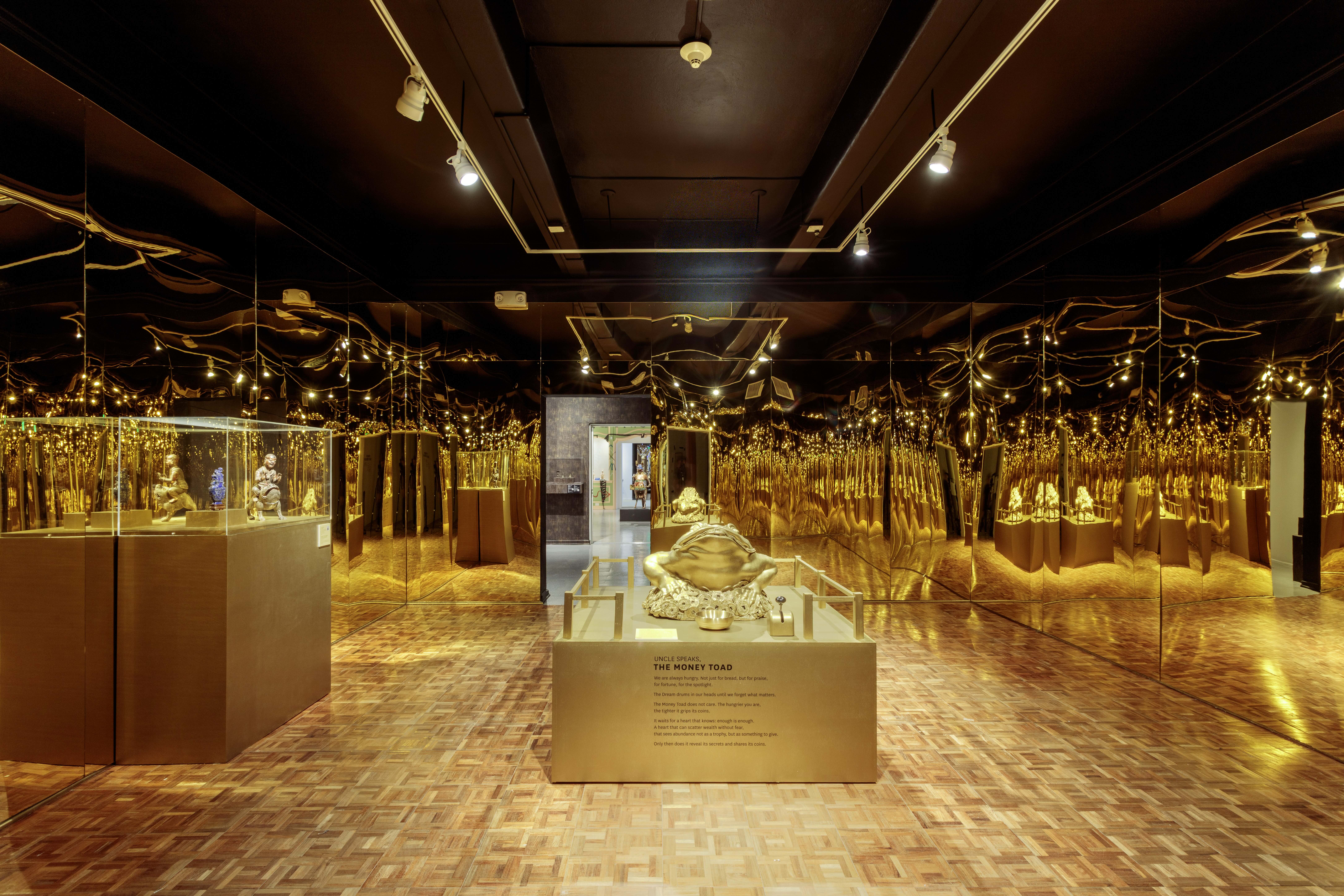
USC Pacific Asia Museum. Photo: Joshua White/JW Pictures
Bringing AAPI Immigration Stories to Life Through Art and Mythology
An Interview with Dave Young Kim
.png)
In an immersive, artist-led exhibit on now at the USC Pacific Asia Museum, immigrant stories are reimagined and recounted through the iconography of pan-Asian mythology.
Mirroring the physical and emotional journeys that immigrants have made to come here, visitors to Mythical Creatures: The Stories We Carry make their way through 12 rooms, each a different creative environment. The exhibit includes over 100 objects from the museum’s permanent collection, as well as works by 24 contemporary artists. From a gallery protected by the Four Guardians—each pulsing with light and energy—to an infinity room featuring a gold Jin Chang toad that dispenses coins, to a recreation of an airplane flight to the United States, we’re guided through collective immigrant memories. The written words of an elder, “Uncle,” give advice along the way.
We spoke with Korean American artist Dave Young Kim, the Lead Curator and Artistic Director of Mythical Creatures, about his background and how he created the exhibit.
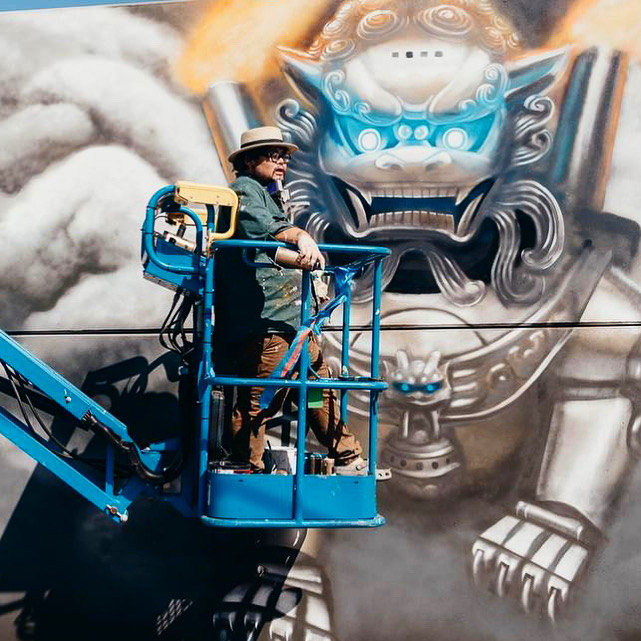
Tell us a little about your personal story and your work.
I have ADD, and as a child my mom put me in every activity possible and nothing stuck. When she put me in art class at five years old, that's what really connected to me. That's where the art started in my life. Growing up in LA in the nineties, I got involved with some things like graffiti and gangs, and that's where the wall work came from. I really figured out my own language for doing that. And as I got older and was growing out of the delinquency aspect of it and really trying to bring meaning into the world, really understanding conceptually what I wanted to do with my life and how I wanted to connect to people, that's when the language for my murals came out.
I went to Northern California to go to school at UC Davis, and got my formal art education there. I did my MFA at Mills College in Oakland. That was 10 years after undergrad. [I was] still trying to understand how to build art as a career while doing it on the side. I draw a lot from my personal culture, the stories. I’m not an immigrant myself—my parents are—but it's very close to us growing up. It feels like their story is an unbroken connection to us. So my work's very tied to the immigrant experience and ways we needed to find refuge and identity and protection through those means.

What was the inspiration behind this exhibit, and how did you come up with the idea of connecting the mythical creatures with immigrant stories?
I have a connection with the museum because I've done that [outer wall] mural for them. That was a couple years ago. That one is also about the immigration story. Each of the birds represent different Asian and Pacific Islander cultures, and it's the idea of them migrating as a flock and landing somewhere—the “somewhere” is clearly here. That's always part of my personal practice––telling stories very rooted in the Asian community and marginalized communities as well.
And then unexpectedly, I got a call and the director asked if I wanted to do something with mythical creatures at the museum. I completely misunderstood what that meant. I thought it was going to be just a small side project. I did not anticipate it taking over a year of my life just to think about and put together. But I said yes. And then quickly it became clear what the scope of it was. But for me, I love that it was mythical creatures…because there are inherent narratives built into mythical creatures that makes it interesting.
But I wanted it to tie it into my personal practice. How is it connected to the world outside? I decided it needs to be about this particular story, the immigrant story. It took me over four months to figure out how to connect the two. So it was not easy. It was very challenging. Now it seems like it's very natural that they connect together, but for four months I could not crack that code. I was literally trying to crack this code. That's what it felt like. How do you tell both those stories simultaneously and visually make it make sense?

What do you hope that visitors to the museum come away understanding or feeling after seeing the exhibit?
I'm a big fan of film. When I watch movies, I'm dedicating two hours of my time. I want to be moved by that film. I want to come away with it reflecting on my life, or at least emotionally changed or shifted…that's how I like to engage in film. So I thought of this as a film, and I wanted people to experience it in a very deep way, in a way that it's connected to their own memory and their own experience. I wanted people to cry. I wanted people at some points to connect it to something that was truly emotional. Because for me, that's how I remember things. That's how I'm forced to consider things and I wanted the story to be really relatable to anybody.
Even though I'm of the art world, what I don't appreciate in the art world is there's a level of elevation you need to present to feel like it's quality work, but I feel like 99% of the people don't understand it, [or think] that's not for them. And if you're just making art for other artists or other curators or the ones in that world, that's pointless to me. So I really wanted to be very accessible in that sense, so that everyone can relate.
Everyone's faced challenges, everyone's faced some kind of displacement. Everyone's faced feeling like an outsider at some point in their lives and needed resilience, and everyone's looking for home.
There is no right or wrong way. Just walk through these 12 rooms and then see how you feel at the end and see if there's anything that triggers empathy or sympathy or something that resonates with your own life. I think that way you'll start to think differently because it's on your own terms. It's not something I'm forcing you or telling you to do. And obviously it's very much about the immigrant story. Each step of the way is a different experience in the immigrant story, but in a very generalized sense. I think in a way everyone can relate to that. Everyone's faced challenges, everyone's faced some kind of displacement. Everyone's faced feeling like an outsider at some point in their lives and needed resilience, and everyone's looking for home.
To celebrate AAPI Heritage Month, admission to the USC Pacific Asia Museum is free throughout the month of May. The exhibit runs through September 6, 2026.