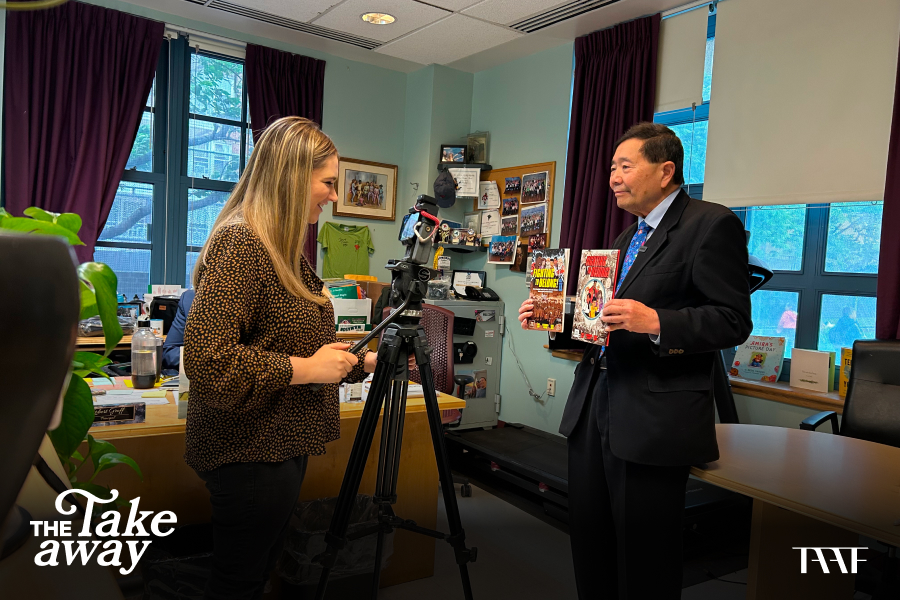
Act To Change Youth Ambassadors David Siu and Megan Sugiyama.
How Act To Change is Developing Young AAPI Leaders and Upstanders: An Interview with Two Youth Ambassadors

October is National Bullying Prevention Month, so we’re taking a closer look at how TAAF grantee Act To Change is empowering AAPI youth to stand up to bullying.
One of the ways Act To Change does this is through their Youth Ambassador Program, an eight-month leadership development and upstander program for AAPI high school students. Through this training, young people learn how they can take a stand and help build more inclusive communities. We chatted to two Youth Ambassadors, David Siu and Megan Sugiyama, who were part of last year’s cohort. Both are currently juniors at Campolindo High School in the San Francisco Bay Area.
TAAF: Where did you first hear about Act To Change, and what made you decide to get involved?
David: I'm also part of AAPI Youth Rising, which is another youth-led organization. And from them, I heard about Act To Change. I heard about all the amazing stuff they do that's really amplifying the voices of youth to speak up and also make change in the community.
Megan: I heard about Act To Change from my brother who is also a Youth Ambassador. He graduated from high school two years ago.
TAAF: What are some of the unique challenges that you would say AAPI youth face when it comes to bullying?
Megan: I would say bullying sprouts from the stereotypes that have been in our society before we were even born. I think that has a huge impact on the way people view Asians and how people treat Asian youth. And I think that is the root cause of bullying for AAPIs.
David: I think just adding on a little bit to what Megan said, something like the perpetual foreigner myth is a great example of one way that someone could be targeted just by the way they look, by their identity. And that's partially the mission of Act To Change, to fight against identity-based bullying. I'm sure we all saw 2021 as the turning point not just for the COVID-19 pandemic itself, but the Asian American hate that soon followed. But it's beyond just what people say. It's also about how it affects us, our mental health.
TAAF: Is it something that you've experienced firsthand, and is that what made you want to get involved?
David: Not only things that I experienced myself through bullying, but also my friends, my colleagues at organizations, they all experienced the same thing. There were these shared experiences that all came together and made me want to take action, made me want to join this movement against identity-based bullying.
Megan: I also think sometimes it can start when we're young, and often I see it in my own Asian friends. It shows how racism has kind of been internalized in a way. And again, it spreads from these stereotypes, but I also think fighting against these stereotypes will help make Asian youth feel more supported and safe.
TAAF: How do you think things are now compared to that time during and after the pandemic?
David: I think that we have definitely made a lot of progress. I mean, just looking at legislation, you can see the mandates of ethnic studies. You can see that now we're learning about Asian American history and a push for AP US history when we learn about Japanese internment camps. And I feel like the most important thing is to take action, you have to be educated first. There's also new organizations like TAAF, obviously, Stop AAPI Hate, AAPI Youth Rising. We all started from this movement because we all had the same shared mission. So on the legislative side and on the education side, we really have made a lot of progress.
Megan: I would just add that the increased advocacy from Asian American youth has improved since the pandemic.
TAAF: Can you tell me a little bit about some of the specific programs you worked on as Youth Ambassadors?
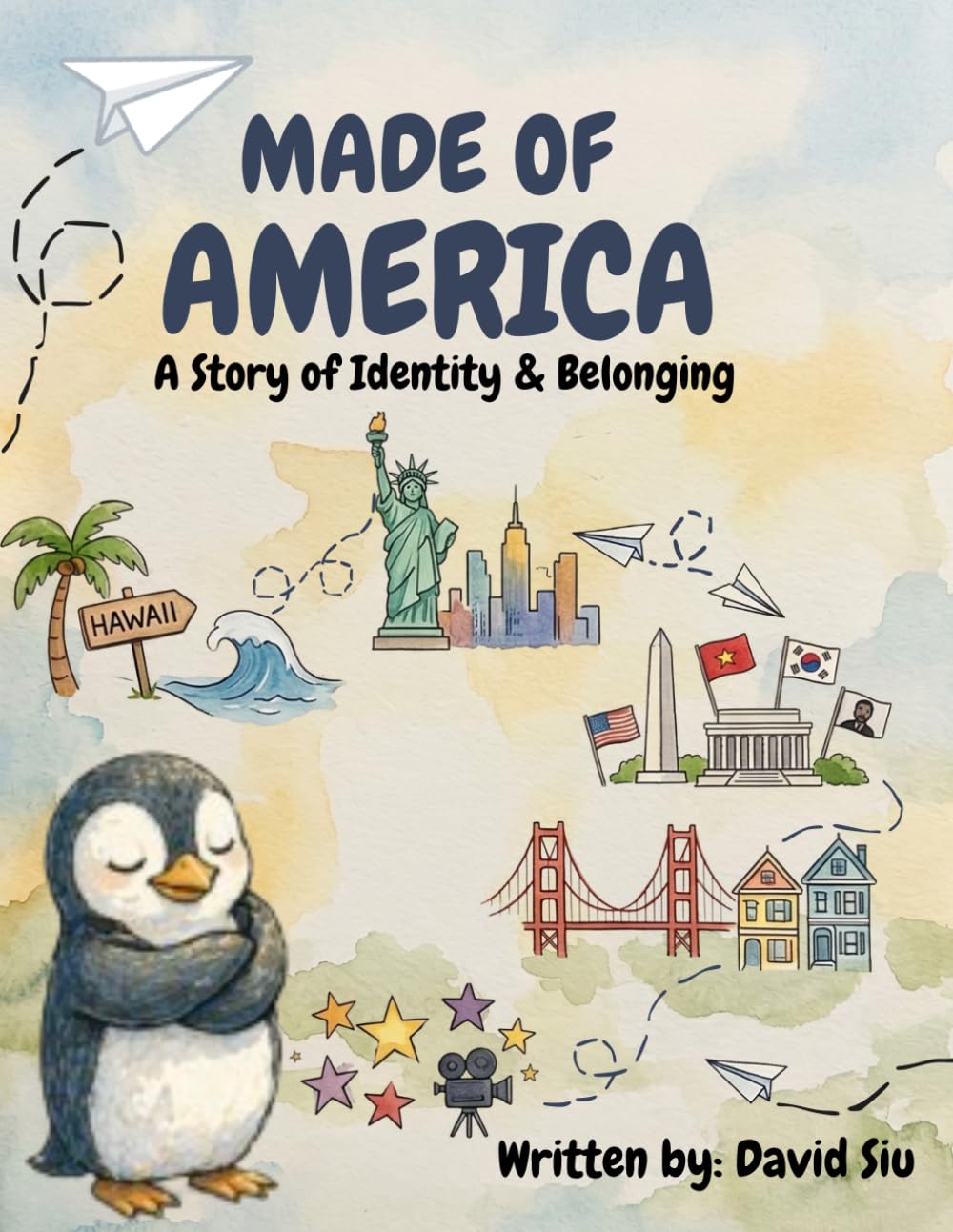
David: So at Act To Change, for my Impact Project, I published a book. It was all about identity and belonging within America, and told a story about a little penguin named Pip who traveled all across America and experienced this melting pot of culture, and that's really what America is. I learned from start to end not only how to publish a book, but I got to learn more about my identity and other people's identities through interviews.
Another thing that we have in the Youth Ambassador Program are Capsite Projects. It's basically a mini internship where you get to go in depth into another organization. I was happy to go and take part with FYLPRO [The Filipino Young Leaders Program] which is all about Filipino advocacy, and I was able to learn about how different organizations work.
Megan: For my Impact Project, what I did was I created these mini lei kits. I visited all of the schools in my district—three elementary schools, one middle school, and one high school. And during lunch, I went to their schools and I invited everyone to just make leis to appreciate Hawaiian culture. And as background, I'm from Hawaii. I was born there and raised there, and I saw the stereotypes of Hawaii being a beach state, like somewhere you go on vacation, ignoring the deep culture that comes with Hawaii. I wanted to amplify their true culture through lei making. So in the end, I was able to reach 1,000 students, and I loved doing that. And then for my Capsite Project, I worked with NAAPIMHA, the National Asian American Pacific Islander Mental Health Association, and I worked with other fellow Youth Ambassadors on a design that focused on the mental health perspectives from generations across AAPIs.

TAAF: What would you say to people who think that kids bullying other kids is just the way things will always be? And how do we begin to change the culture?
David: I think the first half is understanding the situation. So I think just bringing awareness about the issue of bullying and also realizing that it's not only Asian Americans, but there are so many youths around the world who are also being bullied. You can look at the statistics—it's beyond just being bullied. Even when someone tells an adult, only one in three adults take action after being told that a kid was being bullied. I'm working with Act To Change right now on their October campaign, and with that, you're learning about all these different stories.
Megan: I think it is possible through education that truly represents Asian Americans as well as increased awareness.
TAAF: And what part do you think family and community plays in this? Is this something that parents should get involved in?
David: I think they definitely should be involved, and that could be as simple as just listening or asking questions. Oftentimes when my mom asks me, "How's your day today?" she's not actually wanting to know how my day was, she was just asking a question. So I think asking more deep, provocative questions is a lot more impactful for us. I think that's a great way for our families, our community to get involved. To get a better understanding of how we are actually feeling. And understanding the mental health aspect is another really good part of it. When we have these intergenerational conversations, it creates a space for adults as well as kids to understand bullying is actually a really bad thing. We can't just be quiet if we notice bullying happening. We can't just sit quietly by, going along with the model minority myth or [the idea] that “Asians are always quiet.” We have to understand that you have to speak up.
When we have these intergenerational conversations, it creates a space for adults as well as kids to understand bullying is actually a really bad thing. We can't just be quiet if we notice bullying happening. -David Siu
Megan: Yeah. And I often think that Asian American youths, when they are victims of bullying, often hide themselves—-they won't tell anyone. And I think that parents play such a big role in a kid's development, and I think them being there as role models as well as someone who of course can listen to them, I think that's a helpful way to help those who may be struggling with AAPI hate. On top of that, educators, the community, I think they can also play a big role, ensuring the schools foster a safe place where kids can seek help.
TAAF: David, you brought up mental health. TAAF's youth mental health study showed that there's still a stigma in the AAPI community around seeking mental health help and bringing it up to your family, or even friends. In your age group, do you think that's changing? Are kids more open to talking about that sort of thing or asking if they need help?
David: I think that there's still this issue about the stigma, being seen as weird if you speak up about your mental health, about seeking access to mental health. Asian American youth are among the least likely to seek access to mental health services. But I think schools are now changing and shifting direction to do a much better job. If you look at our schools, in ethnic studies as well as in our HSD [human and sociodevelopment health] class, which are both mandatory classes, we learn about these things. We learn not only how it affects kids in general, but also specific racial groups as well, and they promote these conversations to talk about your mental health, which I think is really important. I definitely think that our schools and our communities are slowly moving in the right direction of creating these conversations about mental health.
I started a mental health club called Active Minds, and it's student-led, it's peer-to-peer. I think that really helps open a space where students can come and seek help. -Megan Sugiyama
Megan: I think there is still a lot of stigma surrounding mental health and seeking help. My school has a wellness center, and I think the team at the wellness center has been doing a better job encouraging students to come, making activities where there would be a week-long mental health week. So I think in that aspect, it has improved. I started a mental health club called Active Minds, and it's student-led, it's peer-to-peer. I think that really helps open a space where students can come and seek help.
TAAF: What are some positive outcomes from the work that you've done either directly as part of the Youth Ambassador Program, or using the skills you learned there?
Megan: Because I visited so many schools in my district, I was able to connect to my community more, and understand them. Also when we were making leis, I had the opportunity to talk to the students one-on-one, and that's when I really had a deeper understanding of the experiences they were telling me [about], because there's a very small minority of students who are Native Hawaiian or Pacific Islander, and I think they really felt appreciated and seen from my project, and that had a huge impact on me.
David: So after Act To Change, there's a few things I did. The first thing is with AAPI Youth Rising, which is the other organization I lead. We're the largest youth-led AAPI organization in the world, and we are currently reframing our entire lesson plan, creating one that's focused on not only Asian American history, but also upstander bullying prevention sort of stuff, and creating different levels for middle school and high school, which are direct curriculum that we learned at Act To Change.
And then the other initiative I'm working on right now is with Better Youth Futures. I'm the executive director of that organization, and I'm working with Act To Change on this new initiative called Pie the Silence Campaign, which is anti-bullying, and it's a social media campaign that's already reached 13 states as well as two other countries besides the US. It's kind of like our take on the USC Speak Your Mind Challenge, except this time it's with whipped cream instead of an ice bucket. You basically pie yourself and you say, "I nominate X, Y, and Z for the 2026 Pie the Silence Challenge.” And it's this really big way to gain awareness about the anti-bullying work going on around the world and bullying prevention as a whole in October.
You can be a part of building the movement for belonging and inclusion. Learn more about Act To Change’s ACTober Against Bullying campaign and sign the pledge here: https://acttochange.org/impact/actober-against-bullying/