John Cho as Pastor Hwan and Mahershala Ali as Latif. Courtesy of Amazon MGM Studios.
John Cho on Bringing Depth to the Role of Unhinged Pastor in ‘Your Mother Your Mother Your Mother’
.png)
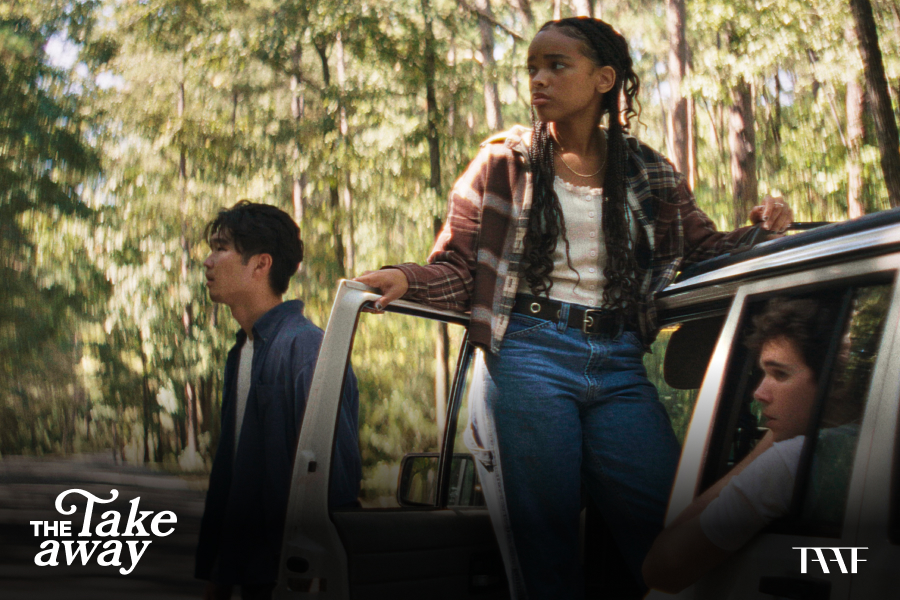
In Bassam Tariq’s new film Your Mother Your Mother Your Mother, we see a devout Black Muslim hitman go up against a heavily armed Korean American Christian fundamentalist. But their fight is not over a difference in faith.
Latif (Mahershala Ali) is a reluctant hitman trying to acquire breastmilk for his daughter after his wife’s death. And John Cho plays Hwan, a gun-toting and grill-wearing pastor who’ll use any means necessary to abolish pornography. Their paths cross when the nephew of Latif’s handler becomes the target of Hwan’s crusade. Mixing action with family struggles, the film shows both men coming to terms with their faith through a final, very bloody confrontation.
I caught up with John Cho to chat about playing the intensely scary Pastor Hwan, the power of telling stories from across communities, and what’s changed in Hollywood since he started out as an actor.
You play Pastor Hwan, a violent fundamentalist who's really different from the roles many people might associate you with. What was it like bringing this character to life, and what or whom did you draw on for inspiration?
Well, it was definitely a collaborative process putting this person together, and it was probably the most I'd worked with a director to create somebody. And even on the page, it was very difficult to tell what he might look like, sound like. There's some evidence of what he believed, but we really had to put this backstory together and we got in a room and just started talking. And Bassam, the first thing we decided was that he was going to be not a crook, not a charlatan, but in his mind really doing the Lord's work. And then after that it was putting a biography together.
And I think the hardest thing for me was probably really making him specifically Asian American, opening my mind up to that because I think I probably had a mental blockage because as we went forward into fittings and started talking about things, I realized I really had no frame of cinematic reference for somebody like this. And he's just so unusual to begin with. And so I was just having a hard time getting around it. And Bassam was pulling references, pop culture, people in culture, but also people he knew. And so we just talked about people we knew and just kept working through it and discussing what his history was until we landed on that.

I like that you mentioned he’s really a believer—he and Latif seem like two sides of the same coin. How do you see their relationship, especially at that end moment when Latif gets back up after being shot?
I think for me, that moment is these two men in the aftermath of having witnessed a miracle. And for Hwan, I think he's going, "How did God work for this man? What does that mean?" And he doesn't know in that moment. He just wants to ask a question and start there. And I think it'd be very interesting to know where he went, how that alters that pastor's life, because these are events I think he would not have foreseen. And he's having to wrestle with rearranging his idea of who God is at that moment. It's a lot to deal with. And especially after you really see a physical manifestation of a miracle, this is real evidence, something divine happened. Now I have to figure out who that divine force is, what that divine force wants, what that divine force believes or wants of me. And it's the second time in his life he's seen a miracle. And the first one in his mind was when his mother prayed for him and saved him in Iraq, and now he's seen it happen to someone else. So he's trying to figure all that out.
This is truly an outsider story centering Muslim, African American, and Asian American characters. What does being a part of this kind of story mean to you?
Well, I guess I've been the beneficiary of—and I'm taking this many, many years back—people in America saying, "I'd like to tell my story." This goes very far back to African American and Native Americans, and then in the '70s, Asian Americans really finding their voice politically. My first play was an adaptation of a book by Maxine Hong Kingston, and that was a reaction to the political environment at that time. And so I've just been in that soil and that's the atmosphere that has allowed the plant that is me to grow. So I'm the beneficiary and I'm happy to participate. This is kind of part of my life. And right now where we just have such explicit xenophobia as it relates to Muslim Americans—that this is not a political statement necessarily—I'm just saying that it's humanizing this community. And that step one to doing anything at all is just to look over and say, "These are human beings. Let's get something done." And so this is not a social work, this is a work of fiction, this is a work of entertainment, but I do love that about it and I think it makes it richer.

In the '90s and 2000s, you were one of the few faces of Asian American representation on TV and in movies. How have the roles that are available to you changed over time, and where do you think Hollywood could still do better?
I have always felt like I'm not completely in the Asian entertainment economy. Partially because I'm monolingual for the most part, so I have just sort of been outside of that economic engine, it feels like, and that doesn't seem to have changed over the years. And so it's just always me going out there and reading scripts and trying to do my best.
But looking from afar, clearly things have gotten better. And I think we're not probably where we should be or where we want to be. There's much more work to be done, but there are things that really encourage me. And it's not necessarily about we have this guy or this gal in this kind of movie, and now we have someone in this kind of movie, and it's not necessarily hitting benchmarks for me, but what I see is the health beneath the surface. I would say I've met a lot of writers and directors who are very talented, and I've met actors who are very talented, and I've met studio executives who are trying to open up stories. And year by year and project by project, you may not see all of that, but I see on the human resources side, I see lots of signs of good health moving forward. And that's encouraging because you can have a hit and you can have a down year, but as long as there are more people, talented people entering in, you're probably in a good place. That's where you want to be.
At TAAF our Asian+American campaign is celebrating the people in our community who are pioneers across different industries. Who do you consider an icon?
I'll tell you one that people don't talk about. There's a guy named Phillip Rhee. He's a Korean American actor/martial artist. And when I was in high school, he made these lower budget action movies, and they would be on straight-to-video and stuff. And he was this great looking guy with big muscles and was an incredible taekwondo artist. And many years later, I met him and we had a chat and he was still doing his thing, trying to get movies off the ground, but I was like, this is an Asian American independent filmmaker doing it in the '80s on his terms. He was being a hero, being the lead of his own martial arts films, and he was an entrepreneur. In the discussion of Asian American filmmakers, I would like to throw a spotlight on Phillip Rhee.
Your Mother Your Mother Your Mother is now playing in theaters.